Why E-learning Tracking is Business-Critical? More Than Just a Checkbox
•By AlonLearn Team
For many, e-learning completion is seen as a purely administrative task—a "check in the box." In reality, tracking learning is the very foundation of safety, compliance, and professional integrity.
In this post, we’ll take a closer look at why documenting learning is vital, what we mean by "The Big Four" of tracking, and how modern technology allows us to go deeper to build a healthy corporate culture.
Why is Documenting Learning So Important?
It’s about much more than just statistics. Documentation serves as a company's "burden of proof" and quality assurance in three critical areas:
Safety and HSE: For Health, Safety, and Environment (HSE) and technical safety courses, documentation is a legal requirement. In the event of a public audit, inspection, or—in the worst-case scenario—an accident, the organization must be able to prove that employees received and understood the necessary training.
Customer and Market Requirements: Customers increasingly demand documented competence from their suppliers. Being able to showcase up-to-date competency records provides a competitive advantage and builds trust during tender processes.
Certification: For many professions, regular knowledge updates are required to maintain licenses or certifications.
"The Big Four" – The Pillars of Tracking
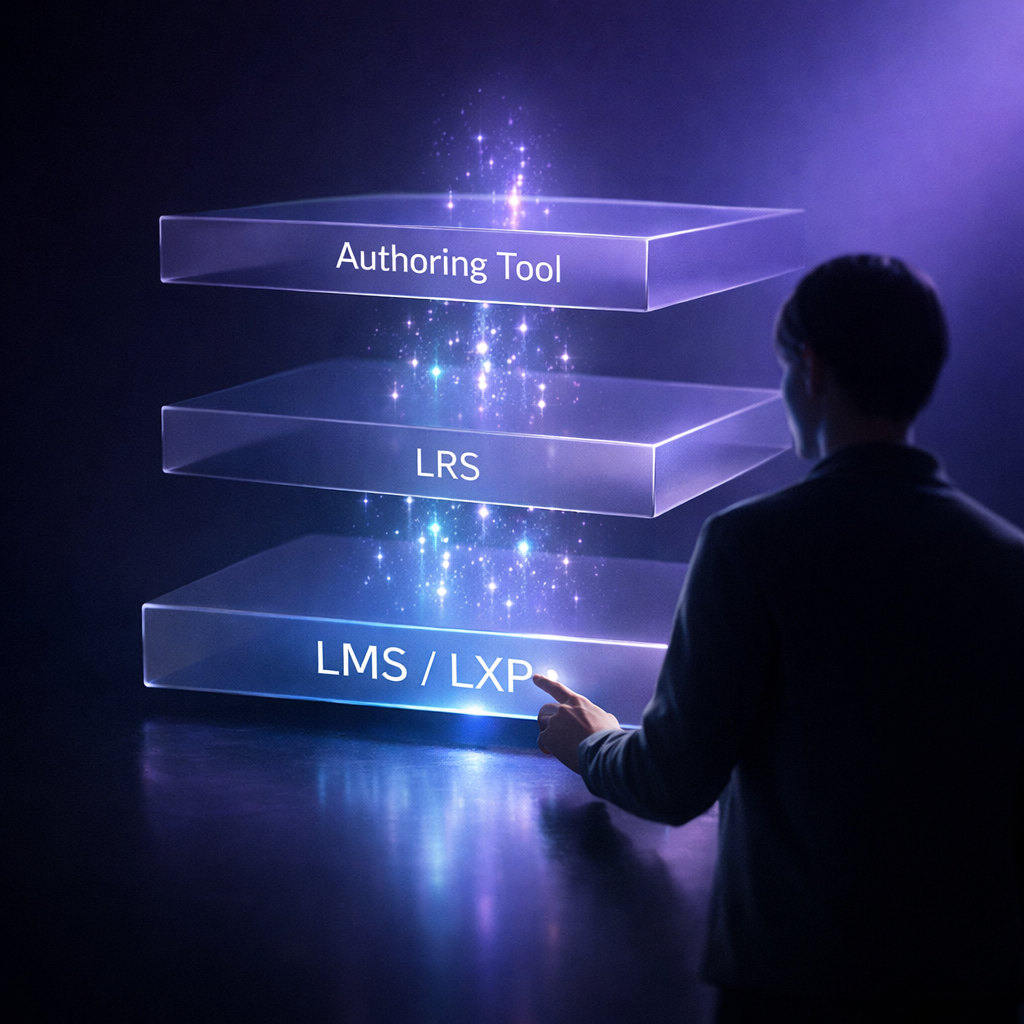
Most e-learning courses today are delivered as SCORM packages. This is an international standard that allows the course to communicate with a Learning Management System (LMS). Within this standard, we typically operate with what we call "The Big Four":
1. Completion
This is the most common parameter. It indicates that the participant has navigated through all the content. Modern players, such as the one in AlonLearn, can be configured so that users cannot fast-forward through videos or skip pages, ensuring the content has at least been displayed on the screen.
2. Time Spent
How long did the participant spend on the course? If a course designed for 30 minutes is completed in 2, it’s a clear indication that reflection was skipped. Time spent is logged in the AlonLearn statistics tool, providing administrators with valuable insight into course difficulty and participant engagement.
3. Score
Through quizzes, exams, and tests, participants collect points. You can set specific requirements for the percentage of correct answers needed to pass. In AlonLearn, you can also implement logic that requires the entire course to be retaken if the test is failed, forcing a review of the material.
4. Pass / Fail
This is the final status based on the score requirement. In AlonLearn, a "Pass" status is often linked directly to the issuance of a course certificate. Once the requirement is met, the certificate is generated automatically—an efficient way to give the participant immediate recognition of their competence.
Join Chris Tomkins from SCORM Cloud in conversation with Jens Christian Bang from AlonLearn in this video about e-learning tracking and 'The Big Four'.
When "Completed" Isn't Enough
Many simple e-learning courses are built so that a user can just click through until they happen to hit the right answer on a multiple-choice question to achieve "Completed" status. This encourages "guessing games" rather than actual learning. Therefore, it is often necessary to combine several of the parameters above to get a true picture of competence.
But what if you want to measure more than just knowledge? What about attitudes and culture?
Advanced Tracking with xAPI and CMI5
Sometimes "The Big Four" aren't sufficient. Imagine a construction company that wants to uncover a "bad culture" regarding the use of corporate discount agreements for private purchases, or worse, charging private items to the company account (which can qualify as embezzlement).
If a participant answers "incorrectly" to such an ethical question in a course, modern standards like xAPI and CMI5 can:
Trigger an immediate alert to their direct manager.
Automatically enroll the participant in an extended course on ethics and internal guidelines.
This requires a more advanced technical infrastructure. AlonLearn supports both xAPI and CMI5, enabling the tracking of complex events and deeper insight into the organization's adherence to internal policies.
Summary
Tracking in e-learning is a powerful tool for building competence, ensuring safety, certifying staff, and developing a strong corporate culture. By using this data actively, you move from assuming employees know the job to knowing they do.
Contact Us
Want to Learn More About AlonLearn?
Have questions about how AlonLearn can help your organization? We're here to help you find the best solution for your needs.